

Could your website be working harder for you?

Could changing the suggested donation amounts encourage people to give more to charity without putting them off donating altogether?
That was the question we explored with PDSA, testing whether increasing the suggested donation values would increase average donation value and overall revenue without reducing the number of donations.
Our initial analysis highlighted that PDSA's average donation value was below the industry average, suggesting there could be an opportunity to increase the suggested amounts presented to donors.
This was particularly interesting given wider trends in charitable giving.
Research published by the Charities Aid Foundation (CAF) in 2024 found that the value of donations to charities in the UK reached £13.9 billion in 2023, despite fewer people donating. The increase was driven by people giving larger amounts, with the average monthly donation rising to £65 in 2023, compared with £60 in 2022 and £47 in 2019.
This raised an important question for PDSA - could higher suggested donation amounts encourage people to give more, without discouraging them from donating?
Rather than assuming the existing values were right, we used experimentation to find out.
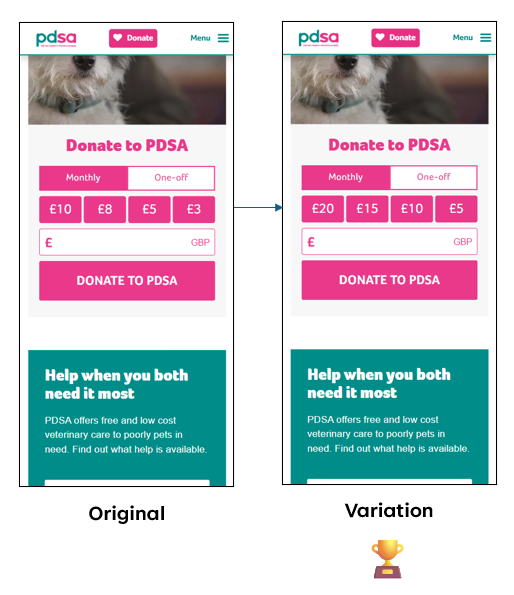
We tested higher suggested donation amounts across both one-off and monthly donations.
For monthly donations, for example, we increased the suggested values as follows:
Increasing suggested values can be a balancing act. While higher amounts may encourage people to give more, there's also a risk that people feel the suggested amounts are too high and decide not to donate.
41%
revenue
35%
average donation value
zero
Impact on donation volumes
The original suggested values may have been limiting how much people were willing to give. By presenting higher amounts, we gave donors the opportunity to contribute more.
We also analysed the results by location and found differences in average donation value across geographical areas. In particular, donors in northern cities appeared more likely to give higher amounts.
By testing assumptions and measuring how people respond, charities can identify opportunities to generate more from their existing donation journeys, helping make every donation go further.


