
Have you seen an increase in Google PPC traffic with a campaign value of (organic) in the past few months? If so, you’re not alone.
Handily, we can tell you why you see it, and what to do to resolve it – and it’s a lot more simple than you might expect!

Background on the (organic) value in the campaign field
We have seen multiple instances where traffic coming from Google PPC, with a campaign name of (organic), have risen, all around the same date in early July, as can be seen in the graph below.
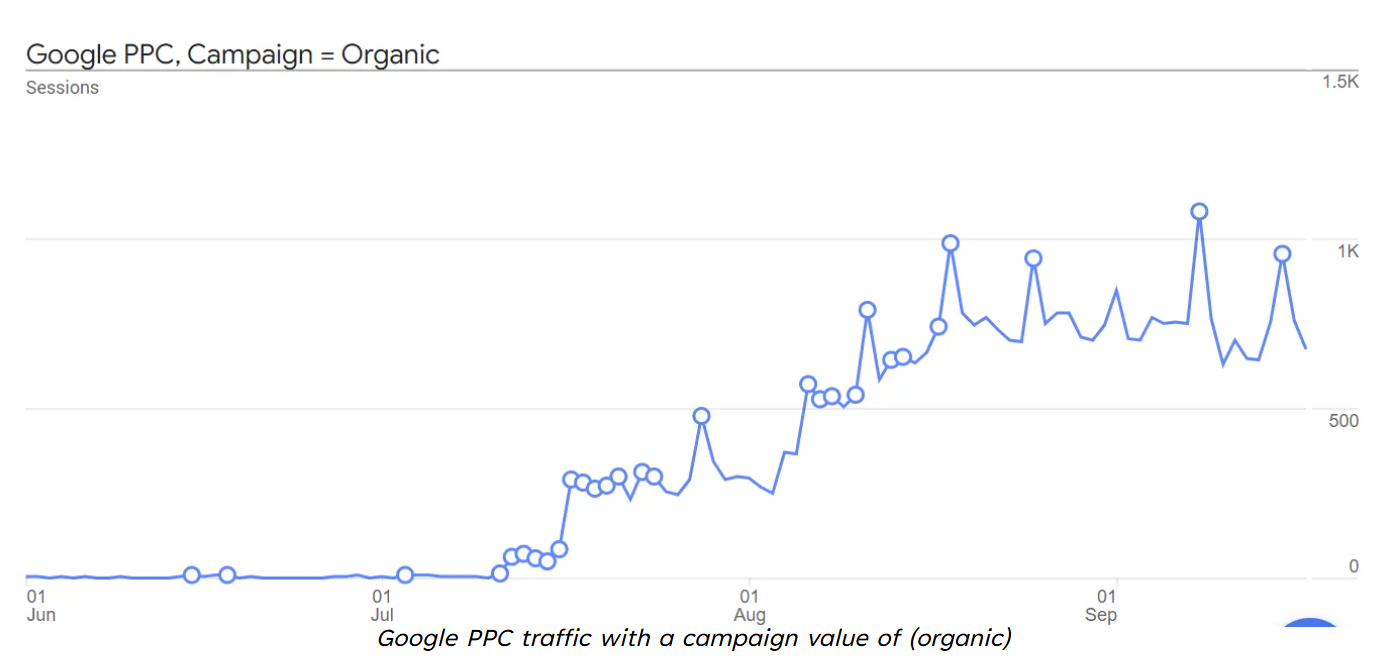
We now understand that this change aligns with a change in the way Google interprets gclid values (the values produced by Google automatically when auto-tagging is enabled), in line with Consent Mode.
Why are we seeing a rise in PPC traffic with campaign set to (organic)?
In short, when the consent type ad_user_data is denied via Consent Mode. As Google outlined here , when this value is denied:
- Ad measurement and personalization for online advertising is disabled, including use cases supported by user_id and user-provided data (hashed, consented user data).
Likewise, when a user hasn’t enabled their Google ads personalisation setting, the same impact is observed.
And what is that impact?
Google cannot retrieve all marketing channel data. This leads to Google PPC traffic being classed correctly, but additional information, such as the campaign name, cannot be collected. Therefore, Google applies the value of “(organic)”.
In plain English, when a user clicks through from a PPC ad with auto-tagging enabled, Google Analytics sees the “gclid” value so it knows it’s Google PPC traffic. But it cannot retrieve the additional information from the Google Ads platform integration due to the consent settings outlined above.
Utilise manual tagging to resolve the issue of (organic) appearing in the campaign field
Manual tagging. Make sure you add utm_ tagging to all Google Ads links in addition to maintaining auto-tagging.
Our tests have shown that when this happens, we are able to use the manual tagging alongside auto-tagging so that in instances where a user has denied consent, we are still able to correctly capture the campaign they have come through.
Although we’ve not tested extensively yet, it makes sense that other utm_ parameters would also pull through, if you wanted to pass additional values to GA4. Stay tuned to this blog - we'll update as our findings come in.
Hope that helps but as ever, get in touch if you want to discuss!
You may also be interested in

Stop Overcounting Product Revenue: Adobe Analytics Adds a Product Level Segment Scope
Read more about Stop Overcounting Product Revenue: Adobe Analytics Adds a Product Level Segment Scope
Why CRO Needs a Human-Centred Approach in the Age of AI
As AI continues to shape how websites are built and optimised, Conversion Rate Optimisation (CRO) is becoming increasingly standardised. We advocate for putting the customer, and human, first.